






Missile Strikes, Deaths And Unanswered SOS Calls Raise Alarm In Gulf Crisis

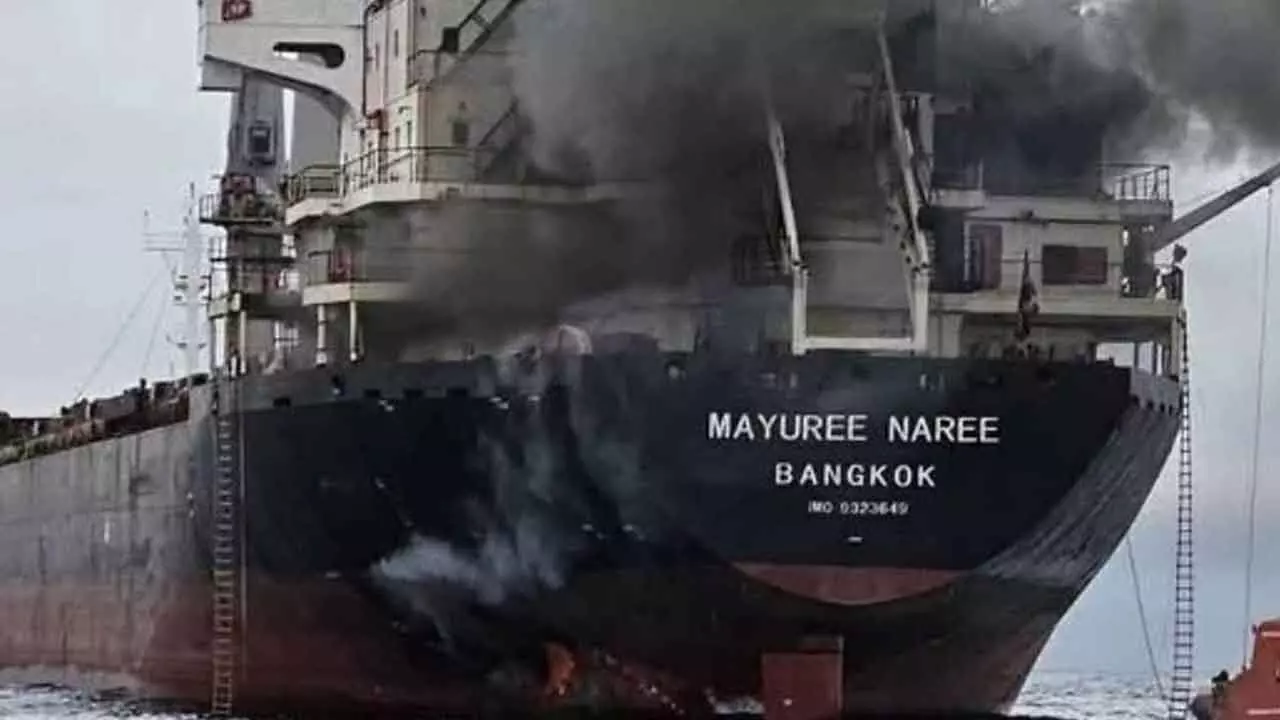
- Indian sailors, who work on merchant ships, are unwittingly caught up in the escalating Gulf crisis.
- Increased missile attacks, deaths and evacuations that are not completed on time and unanswered cries of distress mark the escalating dangers in the Strait of Hormuz.
Tensions keep rising across the Gulf as Indian seafarers on-board with the commercial vessels find themselves on the front lines of a conflict which they have nothing to do with. During the last week, a series of strikes against merchant ships off the coast of the Strait of Hormuz have left three Indian sailors dead, and left scores of sailors to be traumatised by the attacks and the question of maritime security or response to emergencies unanswered.
The crisis erupted when a crewed Indian tanker sent out successive calls for help on unencrypted radio waves. After a military strike, a fire outbreak was reported in the vessel's engine room, where crew members were saying it was raging inside, said to be caused by the explosion. After it was said that a military strike occurred, crew members reported a fire raging in the engine room of the vessel. As flames swept through areas of critical importance on the ship, the panic quickly spread as sailors scrambled to get help.
The attack was among a series of attacks against merchant ships in the vital seaway between the Persian Gulf and Strait of Hormuz. In just a few days, a number of ships, such as Marivex, Settebello and MT Jalveer, carrying Indian crew members, were involved in separate military operations. Many sailors were rescued from the attacks, but three Indians—chief engineer, engine fitter and a deck cadet—on board Settebello were killed.
Videos spreading after the incident depicted extreme damage to the ship's engine rooms, videos showed ships disabled at sea as a result of the fire and explosions. The U.S. authorities said the vessels in question were engaged in operations related to Iran's oil transportation and had violated a naval blockade. Shipping operators, however, disputed those allegations, saying that in some instances, vessels were not warned in advance and on at least one occasion, a vessel was stationary for days before being attacked.
Survival was the priority for those on board MT Jalveer. Although the strike caused extensive damage, all 20 Indian sailors on board were rescued in the end. But the humanitarian situation worsened in the region overall.
This tragedy was compounded by the loss of 35-years-old Indian sailor Nishanth Uirthan who died on board MT Celestial. He was reportedly sickened seriously while the ship was in operation near Oman. Impetuous calls for emergency aid and medical evacuation had been made repeatedly, but without any commensurate response. But as his condition deteriorated, other crew members were only able to wait for assistance which never arrived.
When Uirthanathan died, sailors on board were reportedly having a hard time with maintaining his body as there weren't any proper refrigeration facilities available. Crew members used cold water bottles to retard decomposition and improvised methods of support until they were authorized for and received assistance in repatriation. It demonstrated the real life issues surrounding merchant sailors working further away from port in times of geopolitical tension.
Later, the Indian Embassy in Oman confirmed the sailor's death and said it was working on the matter, to facilitate his mortals returning to India. It has also been said that authorities were in talks with authorities and stakeholders to speed up the process.
In the interim, the incidents against Indian nationals on ships have raised diplomatic issues. India has reportedly brought the matter to the notice of US officials and asked for clarifications on the incidents leading to loss of life and damage to commercial ships. The developments have introduced one more layer of complexity to the already complicated geopolitical scenario in West Asia.
Even as international leaders continue to engage in diplomatic dialogues, risks to seafarers are still real and personal. Merchant sailors still operate on some of the world's most fragile shipping lanes, sometimes with little security against an escalation of military action and regional conflicts.
For families of its victims, the headlines are about more than geopolitics and strategy, but are about life. They are about normal people thrown into unusual situations and circumstances—about those who had gone away to work but who were in an unusal and dangerous situation.
The crisis in the Gulf has escalated and the stories of Indian sailors are a stark reminder of the human toll of international conflicts. Sailors are working and working and working thousands of miles away from home, hoping just to get to their families safely after each missile strike, after each distress call, and after each diplomatic statement.
SHO injured in axe attack during protest over alleged encroachment in MP's Sidhi
Nepal: Tea producers shut factories, say India's strict import rules complicating exports
China attempting to reassert relationship with North Korea: Report
Hyderabad Heroes captain Manuel eyes a stronger comeback after learning from ‘one bad game’ at RPL
Infosys Co-Founder Backs View on Why India Has Not Produced a ChatGPT Rival
Sensex soars 736 points as US-Iran peace deal boosts market sentiment
Nitin Gadkari inaugurates Northeast Infrastructure Summit in Shillong
Missile Strikes, Deaths And Unanswered SOS Calls Raise Alarm In Gulf Crisis
IIIT Bangalore Hosts Fire Safety Awareness and Emergency Preparedness Program
India ‘A’ docked 10 runs as penalty for running on the pitch against Sri Lanka ‘A’


