






Chandrayaan-2 Just Mapped the Moon’s Hidden Fuel Station

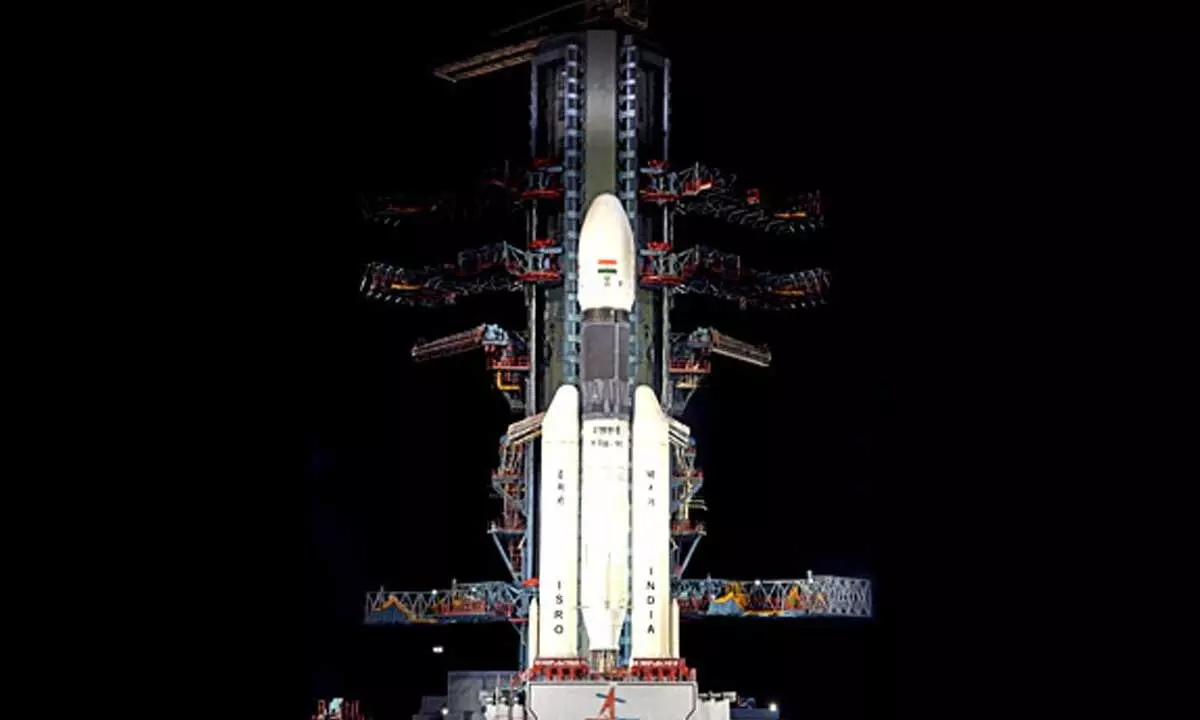
In a discovery that is reshaping the global lunar race, Indian scientists have confirmed the presence of significant subsurface water ice at the Moon's South Pole. Using data from the Chandrayaan-2 orbiter, the Indian Space Research Organisation (ISRO) has successfully "seen through" the lunar surface, identifying ice deposits buried meters beneath the dust—a feat that has eluded previous international missions.
The findings, centered on the Faustini Crater, provide a definitive "map" for future exploration, positioning India as a leader in the search for life-sustaining resources in deep space.
For decades, space agencies have debated whether lunar radar signals were reflecting off water ice or just jagged rocks. ISRO’s Dual Frequency Synthetic Aperture Radar (DFSAR) has finally settled the debate.
By analyzing the way radar waves bounce back from the lunar soil (regolith), scientists identified a unique "blueprint":
* High Circular Polarisation: Indicates the signal is bouncing multiple times within a substance.
* Low Depolarisation: Proves the substance is uniform (like ice) rather than irregular (like rough rocks).
This technological precision allowed the DFSAR to differentiate between dry regolith, buried rocks, and pure subsurface ice located 2–3 meters below the surface.
The Mission Roadmap: From Chandrayaan-2 to LUPEX
While Chandrayaan-2 found the ice from orbit, India’s next move is to touch it. The upcoming LUPEX (Lunar Polar Exploration) mission, a joint venture between India (ISRO) and Japan (JAXA), will send a rover equipped with a massive drill to the exact coordinates mapped by DFSAR.
"The Moon is no longer just a destination," experts say. "It is a fuel station for Mars and beyond."
Why Lunar Water Changes Everything
The discovery is a game-changer for the "Three Powers"—India, China, and the United States—all of whom are racing to establish a permanent presence at the South Pole. Lunar water is not meant for drinking; it is the key to deep-space survival. The discovery of lunar water is a transformative milestone because it provides the two essential components for sustained deep-space travel: energy and life support. Through the process of electrolysis, the water ice (H_2O) found in craters can be split into its core elements. The hydrogen acts as a high-efficiency rocket fuel, while the oxygen provides breathable air for astronauts stationed in lunar bases. Beyond these chemical uses, the water ice itself is invaluable in its raw form, serving as a natural shield against space radiation and acting as a cooling agent for equipment. By harvesting these resources on-site, space agencies can transform the Moon into a functional "fuel station," drastically reducing the weight and cost of missions heading to Mars and beyond.
India’s Strategic Edge
By being the first to successfully land near the South Pole (with Chandrayaan-3) and now possessing the most detailed maps of subsurface ice, India has secured a strategic advantage in the "New Space Race." As the global community looks toward Mars, the ability to harvest "Fuel + Air" directly from the Moon significantly reduces the cost and complexity of long-term human missions.
India now knows exactly where the most valuable substance in the solar system is buried. The race to extract it has officially begun.
NEET Paper Leak Fallout: Dharmendra Pradhan Steps Down as Education Minister, Says ‘I Never Shied Away From Responsibility’
AI Appreciation Day 2026: Trust and infrastructure emerge as the next frontier for AI, say experts
Few Takers for HILT Policy in Hyderabad Amid Low Response
Cockroach Janta Party Protest LIVE Updates: Demonstrators Assemble at Jantar Mantar
Fire breaks out at a building in Ameerpet of Hyderabad, fire brigade arrives
ED’s Vedanta raids raise questions about proportionality, perception


