






- 'Is democracy in India being undermined like China, Russia and North Korea': Gehlot on FIR against Rahul, Priyanka Gandhi
- Delhi Seemapuri Building Collapse: Several Feared Trapped As Rescue Operation Underway
- Claude Users Can Work Across Google Docs, Sheets and Slides In-App
- Rapido Ride Turns Into Nightmare After Captain Flees With Injured Passenger
- 7 Must-Watch OTT Releases For Your Dussehra Holidays
- ‘His Lips Turned Blue’: Dentist Recalls 45-Minute Effort To Save Flydubai Pilot Smit Machchhar
- Airtel Postpaid Plans Bring Free International Roaming From Rs 499
- 'Politics means nation building to him': Rajnath Singh on PM Modi's 25 years in public service
India Is Buying AI. But Who’s Actually Building With It?
In Short
India is transitioning from an AI consumer to an AI builder. Discover why mastering workflows, integration, and cost innovation is India's true AI advantage.

Share :
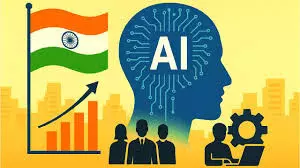
You learn to walk before you run. You import before you invent. You experiment before you industrialize. Likewise, it is natural for nations to first use a new technology before one starts to build with it.
Every major technological shift, whether electricity, the internet, cloud computing or smartphones, has followed a similar pattern. AI is no different. Today, there is hardly any company in India that is not thinking about using or building with AI. ChatGPT subscriptions are active across boardrooms. Indian IT services and product companies are using GenAI to develop, test and release software or deliver services. PowerPoints, infographics and social posts are being created with AI. AI task forces are being formed. Innovation labs are buzzing. New roles are being defined as organizations respond to the avalanche of AI. This is not a bad thing. But it is only the first step.
Consumption Phase Is Natural and Necessary
When a breakthrough technology emerges globally, especially one that requires massive foundational investment like large language models, enormous compute power and large infrastructure, it is logical for most countries to begin as adopters before building deeply with it. History offers many examples where India did not invent the core technology but applied it at scale. India did not invent the Smartphone, yet built UPI on top of mobile infrastructure and transformed digital payments globally. Cloud computing, yet Indian IT services scaled it across the world. E-commerce, but companies like Blinkit and Zepto reimagined instant delivery models. DigiYatra has made airport boarding seamless using facial recognition. India need not start by building foundational LLMs to build extraordinary AI businesses. Real opportunity lies not only in competing at the model layer but also in mastering the application, integration, and workflow layers.
What Is Actually Happening Today?
In many enterprises, AI today looks like this: A chatbot on the website, an AI summarization tool inside Microsoft Teams, A vendor dashboard with predictive analytics. A generative AI assistant plugged into email. These improve productivity and create early excitement. But underneath there is the same: Legacy ERP systems, Manual approval chains, and Siloed data lakes.
Moreover, there are compliance bottlenecks as AI is being layered on top of old systems rather than re-architecting them. AI will augment capability and opportunity by multiple X, but only if organizations redesign how work actually flows.
The hard work has not started yet. True AI transformation requires deeper shifts across organizations. It begins with reworking data systems so that companies have clean, real-time data pipelines supported by strong governance frameworks, context layers and enterprise knowledge graphs. Workflows also need to be redesigned. Instead of a model where humans do everything and AI only assists, organizations will need to move toward systems where AI executes tasks and humans supervise outcomes. This goes beyond basic automation such as RPA or chatbots and moves into intelligent automation where AI agents can reason, escalate issues, learn from results, and continuously improve processes. Achieving this will require a cultural shift. AI cannot remain an IT project handled by one department. It has to become an operational philosophy and a decision discussed at the board level. Alongside this shift will come the need for major investments in computing power, electricity, and data center infrastructure. This is the difficult part, and it is also where India’s real opportunity lies.
Why India Is Uniquely Positioned
India has three structural advantages that position it well for the next phase of AI adoption. The first advantage is India’s deep experience with processes. For years, companies here have run global back offices handling finance, HR, procurement, and compliance for businesses around the world. That exposure has built a strong understanding of how complex workflows operate and how large systems are managed at scale.
The second advantage is talent. India has one of the world’s largest communities of software engineers. Many of them are already used to working with complex platforms and distributed systems. Moving from writing conventional code to managing and coordinating AI-driven systems is therefore less of a leap and more of a natural next step.
Third is a strong culture of cost innovation. India has repeatedly shown the ability to build scalable solutions at costs that global enterprises cannot ignore. As AI moves from experimentation to real operational deployment, the ability to optimize costs will become a decisive advantage. A powerful example of this mindset is Chandrayaan 3, which successfully landed on the moon with a budget of about ₹615 crore, roughly $75 to $83 million, far lower than the budgets of many global lunar missions and even some Hollywood space films.
And Yes -India Will Surely Build Its Own Models Too
Saying India does not need to compete head-to-head in trillion-parameter frontier models does not mean India will remain only an adopter.
Across research labs, startups, and enterprises, Indian teams are already building: Language models for Indian languages and dialects, Vertical models for healthcare, law, banking, and governance, compact models optimized for cost and edge deployment, and domain-specific AI tuned for operational workflows. This is the right direction.
This Moment Is Already Taking Shape
The India AI Impact Summit 2026 in New Delhi concluded with the New Delhi Declaration on AI Impact, endorsed by over 90 countries. The declaration echoed a civilizational principle, “Sarvajan Hitaya, Sarvajan Sukhaya,” meaning welfare for all. The summit highlighted the scale at which AI infrastructure is now being planned. More than $250 billion in AI infrastructure pledges were announced. Among the largest commitments, Reliance Industries announced an investment of about $110 billion, while Adani Group committed around $100 billion toward AI data centers and supporting digital infrastructure.
Global technology companies also signaled strong participation. Microsoft committed $50 billion to support AI expansion across the Global South. Infrastructure investments at this scale signal that the foundational systems for the next phase of AI development are being built. During the summit, Narendra Modi unveiled India’s AI vision called “MANAV,” focused on ethical systems, accountable governance and technological sovereignty. At the same time, Sarvam AI, a Bengaluru-based startup, showcased indigenous large language models with 30 billion and 105 billion parameters, reflecting growing domestic technical capability.
India’s AI progress will not be defined only by building the biggest models. It will also depend on creating language-diverse and efficient enterprise models, developing vertical-specific intelligence, and building sovereignty-compliant systems. Investments, infrastructure, indigenous models, and policy frameworks are all beginning to take shape.
We have learned to walk with AI. The time has come to run and perhaps to lead.
(This article is authored by Siddhartha Chandurkar, Founder and CEO of ShepHertz Technologies)
India condemns attacks on commercial vessels in Black Sea, reiterates call for dialogue and diplomacy
'Is democracy in India being undermined like China, Russia and North Korea': Gehlot on FIR against Rahul, Priyanka Gandhi
SSB pays tribute to bravehearts killed in Maoist attack 15 years ago
SSB pays tribute to bravehearts killed in Maoist attack 15 years ago
Pixel Moments to Politics For Cong As BJP Celebrates Modi@25
Dramatic face-off near Jantar Mantar. Rahul and Priyanka sit on the road
MPs vs Police. Chaos and High Drama Unfold on Delhi Roads
Henri Kagan, Kenso Soai Win 2026 Nobel Chemistry Prize for Autocatalysis
AP cabinet approves 12 agenda items
High Courts should not suggest custodial interrogation of accused, says Supreme Court


