






Fiscal stress, weak policy pull AP down to 8th place

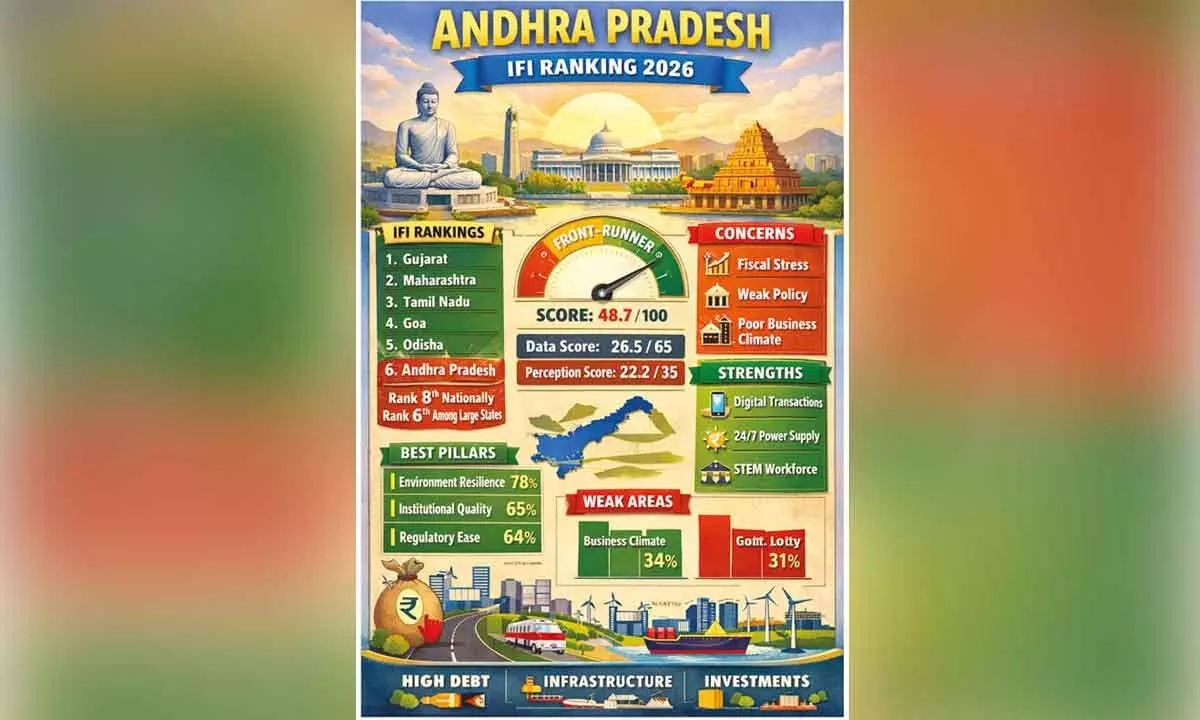
- State slips from long-held No 1 EoDB position to 8th under NITI Aayog’s new Investment Friendliness Index
- NITI flags fiscal stress as the key drag, citing 35 per cent debt-to-GSDP ratio and fiscal deficit exceeding twice the 15th Finance Commission target
- Fiscal Health Index stands at just 23.1
Amaravati: Andhra Pradesh has ranked 8th nationally and 6th among 17 large states in NITI Aayog’s Investment Friendliness Index (IFI) 2026, with fiscal stress, weak government policy indicators and a subdued business climate emerging as the key factors weighing on the State’s performance under the Centre’s new investment assessment framework. The ranking marks a sharp fall from Andhra Pradesh’s long-held No.1 position under the earlier Ease of Doing Business (EoDB) rankings.
The new index awarded Andhra Pradesh an overall score of 48.7 out of 100, placing it in the ‘Front-runners’ category, below the ‘Top Performers’-Gujarat, Maharashtra, Tamil Nadu, Goa and Odisha.
The ranking contrasts with the Andhra Pradesh government’s repeated claims of being India’s most investment-friendly state through its ‘Speed of Doing Business’ initiative. The government has also highlighted that the State attracted 25.3 per cent of India’s proposed investments, led by projects such as data centres, renewable energy, ports and industrial parks.
Unlike the previous EoDB rankings that primarily measured the speed of approvals, the new IFI evaluates States using 84 indicators covering infrastructure, governance, fiscal strength, business climate and institutional quality. The final score combines a 65-point data-based assessment and a 35-point business perception survey.
Andhra Pradesh scored 26.5 out of 65 in the data component and 22.2 out of 35 in the perception survey, indicating that business sentiment was stronger than the State’s underlying statistical performance.
Among the eight assessment pillars, Andhra Pradesh performed best in environment resilience (78 per cent), followed by institutional environment (65 per cent), regulatory ease (64 per cent) and financial health (58 per cent). It scored 48 per cent each in infrastructure and resources, while recording its weakest performance in business climate (34 per cent) and government policy (31 per cent).
Although government policy and business climate are the State’s two lowest-scoring pillars, NITI Aayog identifies financial health as the principal area requiring improvement. The report attributes this to outstanding liabilities of around 35 per cent of GSDP — about 13 percentage points higher than the average for large states — and a fiscal deficit exceeding twice the target recommended by the 15th Finance Commission.
The findings broadly align with NITI Aayog’s separate Fiscal Health Index (FHI) 2026, in which Andhra Pradesh scored 23.1 out of 100 and was placed among fiscally stressed States. However, the two indices use different methodologies, and the IFI’s 58 per cent financial health score should not be confused with the FHI score.
The report also highlights several strengths. Andhra Pradesh recorded the highest digital transactions per capita in the country, about 18, against a large-state average of 4.8. It also reported 23.71 hours of average daily power supply, compared with 22.7 hours for large states, while transmission and distribution losses stood at 14 per cent, better than the category average of about 18 per cent.
The state accounts for around 10 per cent of India’s non-metallic mineral production by value, has the fifth-highest renewable energy resource potential (about 8 per cent), and leads the country in STEM enrolment, with 48 per cent of higher education students pursuing science, technology, engineering and mathematics.
Industry feedback cited Visakhapatnam Port, Sri City, Jawaharlal Nehru Pharma City, APIIC industrial estates and cold-chain infrastructure as key strengths. However, businesses also pointed to poor road quality in tier-2 and tier-3 towns, inadequate airport cargo infrastructure, delays in disbursing incentives, cumbersome utility approvals, gaps in disaster resilience and concerns over policy predictability across political cycles.
The report suggests that while Andhra Pradesh continues to perform strongly in infrastructure, digitalisation and resource availability, fiscal stress, weak government policy indicators and a subdued business climate remain major constraints under NITI Aayog’s broader investment assessment framework.
NEET Paper Leak Fallout: Dharmendra Pradhan Steps Down as Education Minister, Says ‘I Never Shied Away From Responsibility’
AI Appreciation Day 2026: Trust and infrastructure emerge as the next frontier for AI, say experts
Few Takers for HILT Policy in Hyderabad Amid Low Response
Cockroach Janta Party Protest LIVE Updates: Demonstrators Assemble at Jantar Mantar
Fire breaks out at a building in Ameerpet of Hyderabad, fire brigade arrives
ED’s Vedanta raids raise questions about proportionality, perception


