






Why Large SUVs Remain a Popular Choice for Delhi Families

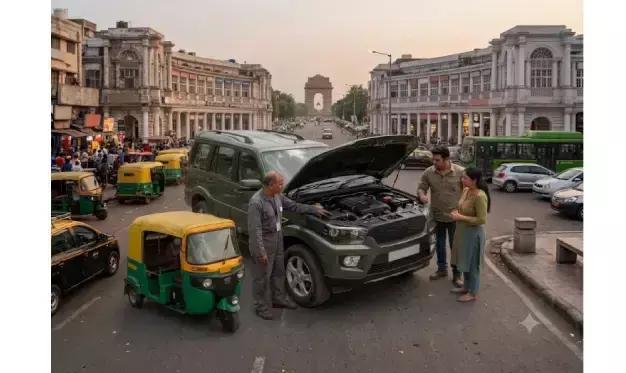
Discover why large SUVs continue to be the preferred choice for Delhi families, offering spacious interiors, enhanced safety, comfort, and the versatility needed for city commutes and long road trips.
Delhi roads test every car. Potholes the size of craters, speed breakers appearing from nowhere, and traffic that turns a 10 km commute into something resembling an expedition. Families here don't just want a car; they want something that handles rough conditions consistently.
That's why large SUVs keep dominating driveways across the NCR, from Dwarka to Noida Extension. And the reasons run deeper than badge appeal or keeping up with the neighbours.
Popularity doesn't automatically make something the right choice, though. So what actually makes these big machines work for Delhi families?
Ground Clearance Isn't a Luxury Here
Most people think ground clearance only matters off-road. That's only half the story.
Delhi throws waterlogged underpasses during monsoon, badly laid road dividers, and unpaved colony lanes at you constantly. A sedan scraping through on modest clearance struggles half the year. A large SUV with significantly more ground clearance handles the same stretch without risk of underbody contact.
Then there's the visibility advantage. Sitting higher means you spot that auto-rickshaw cutting across three lanes before it becomes your problem. In a city where lane discipline is more suggestion than rule, that elevated driving position delivers real safety value, not theoretical but actual.
Anyone searching for a used Scorpio Delhi already understands this intuitively. The Scorpio's tall stance and ladder-frame build handle Delhi's rough patches with consistency.
The Third Row Changes Everything
Here's what most buyers don't consider upfront. Five seats don't cut it when your household actually functions the way most Delhi households do.
Seven or eight seats solve a logistics problem that compact SUVs can't touch. During wedding season, which in Delhi stretches across several months rather than a few weekends, a single large SUV replaces the scramble to book extra cabs for relatives arriving from Lucknow at midnight.
Sounds like an obvious win. It isn't always. Third-row comfort varies wildly across models, and the part nobody tells you is how rarely buyers actually sit in that rear bench before signing the papers.
Some SUVs offer a genuinely usable third row for adults. Others barely accommodate children for anything beyond ten minutes. Sit back there yourself, check headroom and legroom, confirm whether the seat base is properly cushioned, and see how you physically access it before deciding.
Running Costs and the Diesel Question
Running costs for large SUVs can be manageable or genuinely painful, almost entirely based on powertrain choice and your specific driving pattern. Diesel variants typically return better fuel economy meaningfully in stop-start conditions, which becomes significant when you're comparing monthly fuel bills across a full year of Delhi commuting.
Insurance premiums sit higher than compact SUVs. Annual comprehensive cover for a large SUV in Delhi runs noticeably above what a smaller SUV owner pays. Tyres cost more. Brake pads wear faster because the car's weight works against them at every signal.
The common assumption is that large SUVs are money pits. In practice, that's only partially right. Consumables cost more, yes, and purchase price too.
But resale value in the NCR market holds firm for popular models, particularly body-on-frame SUVs that buyers trust for the long haul. A well-maintained example often commands a strong price after several years of Delhi use, which offsets more of that initial premium than most people account for when running the numbers.
For buyers exploring options like a 2nd hand fortuner in Delhi, the Fortuner's reputation for reliability feeds directly into this equation. Its resale curve remains one of the flattest in the Indian used car market, and that changes the total cost of ownership calculation considerably.
Safety Perception vs Actual Safety
It's a bad idea to pick a car on size alone and assume you've handled the safety question. A large SUV feels safer, given the mass, the height, and the sense that you're commanding everything around you. And in certain collision scenarios, physics does favour the heavier vehicle.
But actual occupant protection depends on structural engineering, airbag count, and electronic stability systems rather than kerb weight alone.
Newer models in this segment increasingly offer six airbags, electronic stability control, hill descent assist, and ISOFIX child seat mounts. Older models, particularly those built before updated crash test norms came into effect, may lack several of these features entirely.
The real question isn't whether large SUVs are safe. It's whether the specific model and year you're considering actually carries these systems, or whether a feeling of safety is doing all the heavy lifting.
Check the exact variant's safety kit before committing. A base variant from a few years back and a top variant from the same generation can be worlds apart in what happens to occupants during a serious collision. That gap doesn't show up in the badge on the bonnet.
NEET Paper Leak Fallout: Dharmendra Pradhan Steps Down as Education Minister, Says ‘I Never Shied Away From Responsibility’
AI Appreciation Day 2026: Trust and infrastructure emerge as the next frontier for AI, say experts
Few Takers for HILT Policy in Hyderabad Amid Low Response
Cockroach Janta Party Protest LIVE Updates: Demonstrators Assemble at Jantar Mantar
Fire breaks out at a building in Ameerpet of Hyderabad, fire brigade arrives
ED’s Vedanta raids raise questions about proportionality, perception


