






Can Hyderabad heal its broken chain of lakes?

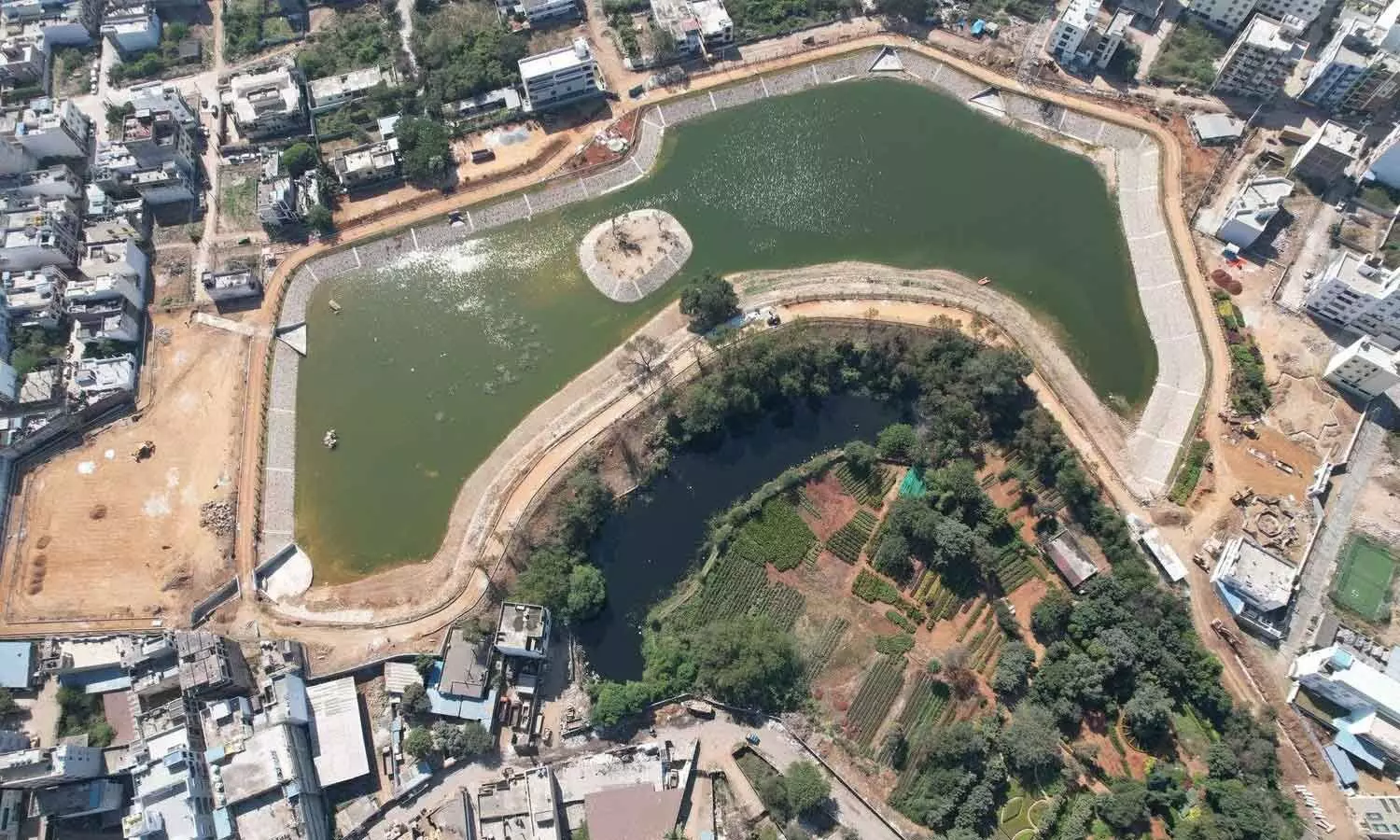
Can Hyderabad heal its broken chain of lakes?
Concretization has completely flipped the city’s terrain
The plan involves completely clearing decades of silt, redesigning choked stormwater channels, and setting up dedicated Sewage Treatment Plants (STPs) to prevent untreated domestic waste from choking the aquatic life. Crucially, the city is also looking at its micro-geography by reviving its ancient bowlis (stepwells)—with structures like the Bansilal Stepwell already restored to hold up to 22 lakh litres of water.
“The grid of concrete will always lose to the geography of water. A city that buries its lakes eventually drowns in its own choices.”
Hyderabad was not merely built alongside water; it was architected by it. Historically celebrated as the “City of Lakes,” its entire topography was designed around a brilliant, gravity-defying system of interconnected water bodies. Until 1908, a network of roughly 60 major lakes acted as natural flood-defense systems, catching every drop of rainwater. In areas like Uppal, Saroornagar, and Hussain Sagar, the overflow from one lake cascaded naturally through canals (nalas) into the next.
According to archaeological evidence, the wider Hyderabad region once boasted between 3,000 and 5,000 vibrant water bodies. Today, that legacy is gasping for air.
The cost of concrete urbanization:
Between 1975 and 2024, Hyderabad lost a staggering 61 per cent of its total lake area. What was once a resilient hydrological map was aggressively fragmented. Village tanks, temple stepwells (bowlis), irrigation reservoirs, and picnic lakes have been treated not as ecological assets, but simply as vacant land waiting to be filled with soil and paved over.
The consequences of viewing nature’s water reservoirs as prime real estate are now felt every monsoon. The 2026 Telangana Lake Health Survey painted a grim picture: out of 185 major notified urban lakes, at least 23 have completely dried up. More critically, the water quality has plummeted severely; key bodies like Asanikunta and Sunnam Cheruvu are classified as “Grade E”—render them biologically dead with dissolved oxygen (DO) levels dropping well below 1 mg/l.
Concretization has completely flipped the city’s terrain. Data from the Indian Institute of Science shows that three decades ago, porous soil allowed 60 per cent of rainwater to percolate into the ground. Today, over 75 per cent of Hyderabad is a solid concrete block, leaving less than 25 per cent of the land surface capable of absorbing water. When climate change slams the city with intense bursts of 40–60 mm of rainfall in just a single hour, the water has nowhere to go. Roads quickly submerge under 40–50 cm of water, traffic gridlocks paralyze the IT corridors, and entire residential areas are hit with devastating flash floods.
The HYDRAA intervention:
Nature, however, does not forget its boundaries. A lake filled with soil remains a low-lying drainage basin, and during heavy downpours, the water will always attempt to reclaim its original home.
Recognizing that urban flooding has turned from a seasonal inconvenience into an existential crisis, the Telangana government took a decisive step by setting up Hyderabad Disaster Response and Asset Protection Agency (HYDRAA). The agency has adopted an aggressive stance against the lake-encroachment cartels that environmentalists have warned about since the 1980s.In a wave of recent enforcement drives, it has reclaimed over 800 acres of encroached government land and lake buffer zones, worth thousands of crores.
The lake restoration strategy:
The agency’s current focus has shifted from demolition to deep ecological rejuvenation. Just recently, it launched a ₹107-crore restoration project targeting four major massive water bodies:
Kapra Cheruvu (112 acres); Ibrahim Pedda Cheruvu (97 acres); Bhagirathamma Cheruvu (54 acres) and Kamuni Cheruvu (48 acres)
The plan involves completely clearing decades of silt, redesigning choked stormwater channels, and setting up dedicated Sewage Treatment Plants (STPs) to prevent untreated domestic waste from choking the aquatic life. Crucially, the city is also looking at its micro-geography by reviving its ancient bowlis (stepwells)—with structures like the Bansilal Stepwell already restored to hold up to 22 lakh litres of water.
The road ahead:
Reversing 40 years of unchecked, chaotic urban expansion cannot happen overnight. While engineered solutions like perimeter fencing, building walking tracks, and developing green buffer zones help protect reclaimed boundaries, the true fix lies in restoring the physical chain links. The canals connecting these lakes must be unblocked, widened, and legally protected from future construction.
This transformation requires deep political willpower and active civic participation. The citizens of Hyderabad must transition from being passive victims of urban flooding to active stewards of their local water bodies. “We do not inherit the earth from our ancestors; we borrow it from our children. If Hyderabad is to survive the centuries to come, it must learn to share its space with the waters that gave it life.”
(The writer is former OSD to Union Civil Aviation Minister)
NEET Paper Leak Fallout: Dharmendra Pradhan Steps Down as Education Minister, Says ‘I Never Shied Away From Responsibility’
AI Appreciation Day 2026: Trust and infrastructure emerge as the next frontier for AI, say experts
Few Takers for HILT Policy in Hyderabad Amid Low Response
Cockroach Janta Party Protest LIVE Updates: Demonstrators Assemble at Jantar Mantar
Fire breaks out at a building in Ameerpet of Hyderabad, fire brigade arrives
ED’s Vedanta raids raise questions about proportionality, perception


